Chronic gut inflammation quietly drives IBS sensitivity, leaky gut, and post-meal discomfort. Here’s how curcumin with black pepper and ginger addresses it — and why bioavailability makes or breaks this supplement.
Gut Inflammation Is Quietly Behind Most Chronic Digestive Problems — Here’s What Actually Fights It
You can rebalance your gut bacteria. You can improve your digestive enzyme production. You can fix your diet. But if chronic inflammation in your gut lining is running in the background — sensitizing nerve endings, degrading the mucosal barrier, disrupting motility — you’ll keep hitting a ceiling in your gut health results until you address it.
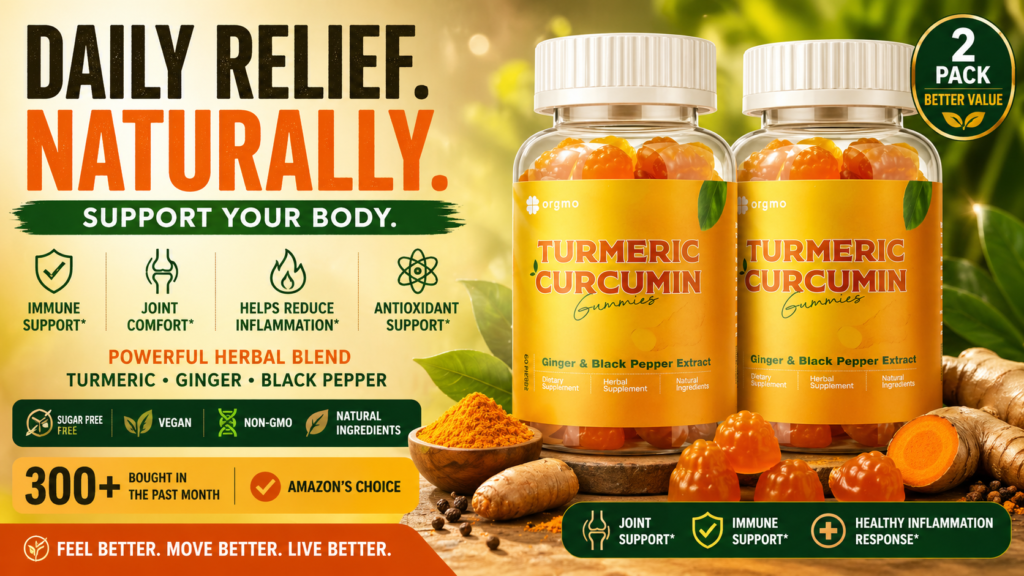
Curcumin — the active compound in turmeric — is one of the most studied natural anti-inflammatory agents in existence. Not in the vague “reduces inflammation” marketing language that every supplement uses, but in actual peer-reviewed research showing specific, measurable effects on the inflammatory pathways most relevant to gut health. The challenge has always been getting it to absorb well enough to matter. These turmeric curcumin gummies with black pepper solve that problem — the piperine in black pepper increases curcumin bioavailability by up to 2000%.
👉 Check the current price on Amazon — Turmeric Curcumin Gummies with Black Pepper
What Curcumin Actually Does in Your Gut
Curcumin’s anti-inflammatory effects in the gut operate through several specific pathways that are directly relevant to the conditions most TummyCure readers are dealing with.
NF-κB inhibition — curcumin suppresses NF-κB, one of the primary molecular switches for inflammatory gene expression in gut tissue. When NF-κB activity is excessive — as it is in IBS, inflammatory bowel conditions, and chronic gut irritation — it drives a cycle of gut lining inflammation that perpetuates symptoms. Curcumin’s inhibition of this pathway directly reduces the inflammatory signaling that makes a sensitive gut more sensitive.
Gut mucosal protection — research has shown curcumin strengthens the mucus layer that lines the gut wall, improving the protective barrier between gut contents and the underlying tissue. A stronger mucus layer means less direct irritation of the gut lining, reduced visceral hypersensitivity, and better protection against the permeability issues associated with leaky gut.
Microbiome modulation — curcumin has prebiotic-like effects, promoting the growth of beneficial gut bacteria while inhibiting the growth of harmful strains. It specifically promotes Bifidobacterium and Lactobacillus populations — the same beneficial strains that quality probiotics introduce. This makes it synergistic with probiotic supplementation rather than redundant.
Visceral hypersensitivity reduction — some of the most interesting emerging research on curcumin in gut health involves its effects on gut nerve sensitivity. By reducing inflammatory mediators that sensitize gut nerve endings, curcumin appears to raise the threshold at which gut stimuli register as pain — directly addressing one of the core mechanisms of IBS and functional gut disorders. The threshold concept in gut sensitivity makes clear why reducing inflammation directly improves how reactive your gut is to normal stimuli.
Why the Gummy Format With Black Pepper Is Actually Smart
Curcumin is notoriously poorly absorbed. On its own, it’s largely broken down before it can be absorbed through the intestinal wall — which is why early curcumin research produced disappointing results before researchers understood the bioavailability problem.
Piperine — the active compound in black pepper — inhibits the enzymes that break down curcumin in the gut and liver, dramatically increasing the amount that reaches the bloodstream intact. The combination of curcumin plus piperine is the most well-validated approach to improving curcumin bioavailability and the one used in the most successful clinical studies.
The gummy format has advantages beyond convenience. Chewing releases curcumin into the mouth and upper digestive tract, allowing some absorption through the oral mucosa before it even reaches the stomach — a delivery advantage that capsules don’t have for upper gut inflammation specifically. For people dealing with functional dyspepsia, upper gut discomfort, or nausea, this earlier exposure to the mucosal surface is a genuine benefit.
Sugar-free and vegan — two boxes that matter when you’re trying to support gut health without feeding harmful bacteria with unnecessary sugar.
The IBS and Chronic Gut Inflammation Connection
For years IBS was described as a functional disorder with no inflammatory component — no tissue damage, no measurable inflammation, just a hypersensitive gut. The research picture has shifted significantly. Low-grade mucosal inflammation — below the threshold detectable by standard diagnostic tests — is now understood to be present in a meaningful proportion of IBS cases and to contribute directly to the visceral hypersensitivity and motility disruption that characterize the condition.
This is why anti-inflammatory interventions including curcumin have shown promising results in IBS research — they’re addressing a real, if subtle, inflammatory component rather than just managing symptoms. Combined with the right probiotic for your IBS type, curcumin provides an anti-inflammatory layer that complements the bacterial rebalancing work.
The Ginger Synergy — What the Combination Adds
These gummies combine turmeric curcumin with ginger — and that combination is smarter than it might appear. Ginger has its own well-established gut health benefits that complement curcumin’s effects rather than duplicating them.
Ginger’s primary gut mechanism is prokinetic — it speeds up gastric emptying and reduces nausea through its effects on the gut’s serotonin receptors. For people dealing with early satiety or post-meal nausea, ginger’s prokinetic effects directly address the delayed gastric emptying that underlies these symptoms. Curcumin addresses the inflammation. Ginger addresses the motility. Together they cover two of the main mechanisms in functional gut disorders simultaneously.
Multiple clinical trials on ginger for nausea and functional dyspepsia have produced consistently positive results — the evidence base here is solid and the combination with curcumin makes both compounds more broadly useful than either would be alone.
Who Should Add This to Their Routine
- People with IBS who haven’t fully resolved their symptoms with probiotics and enzymes alone — the anti-inflammatory layer may be the missing piece
- Anyone dealing with chronic bloating and upper gut discomfort that feels inflammatory rather than purely bacterial
- People with known inflammatory conditions — arthritis, autoimmune issues — alongside gut problems, where systemic anti-inflammatory support has multiple benefits
- Anyone experiencing post-meal nausea or early satiety who wants to address both the inflammatory and motility components
- People who want to support joint health alongside gut health — curcumin’s evidence base for joint inflammation is as strong as its gut evidence
How to Use It
Follow the label dosing — typically two gummies daily. Consistency matters more than timing for curcumin’s anti-inflammatory effects. Take them at the same time each day — with meals to help with absorption, though the piperine enhancement means timing is less critical than it is with unenhanced curcumin supplements.
Give curcumin at least four weeks before evaluating. Anti-inflammatory effects build gradually as curcumin accumulates in tissues — you’re not going to feel something dramatic on day one. The changes tend to be noticed retrospectively — you realize after several weeks that your gut reactions are less intense, your bloating is somewhat reduced, your post-meal discomfort has quieted.
How It Works With Your Broader Gut Health Stack
Turmeric curcumin with ginger sits at the anti-inflammatory and motility layer of a complete gut health approach. It works alongside rather than instead of:
A quality probiotic like Seed DS-01 for bacterial rebalancing. Digestive enzymes like Zenwise for meal-by-meal food breakdown. Magnesium glycinate for motility and sleep support. Collagen for gut lining structural integrity. And fiber support from psyllium husk for microbiome feeding.
Each of these addresses a different dimension of gut health. The complete gut health guide explains how they fit together into a protocol that covers the full picture of what chronic gut issues actually require.
The Verdict
Turmeric curcumin with black pepper and ginger addresses the inflammatory and motility dimensions of gut health that probiotics and enzymes alone don’t fully cover. The piperine-enhanced bioavailability means the curcumin actually gets absorbed. The ginger combination adds prokinetic nausea and emptying benefits. The sugar-free gummy format makes consistent daily use genuinely easy. And the price point for a two-pack makes this accessible for the long-term consistent use that’s required for curcumin’s anti-inflammatory effects to compound.
If you’ve been working on your gut health and feel like you’re doing everything right but still hitting a ceiling — chronic gut inflammation is worth addressing. This is a smart, well-formulated way to do it.
👉 Check the current price of Turmeric Curcumin Gummies on Amazon
Related reading:
- Why Am I Bloated After Every Meal?
- Do Digestive Enzymes Help IBS?
- Best Probiotic for IBS
- Why Do I Feel Full So Fast When Eating?
- Seed DS-01 — Our Top Probiotic Pick
- The Complete Gut Health Guide
About the Author
Marcus Chen is a former pharmaceutical researcher who spent eight years studying anti-inflammatory compounds before pivoting to health writing after becoming disillusioned with the industry’s preference for patentable molecules over well-studied naturals. He brings a rigorous evidence-based lens to supplement evaluation — if the research isn’t there, he says so, and if it is, he explains exactly why. He lives in San Francisco with his rescue dog Koji, who has no interest in gut health supplements but has very strong opinions about walkies timing.
As an Amazon Associate we earn from qualifying purchases through some links in our articles.