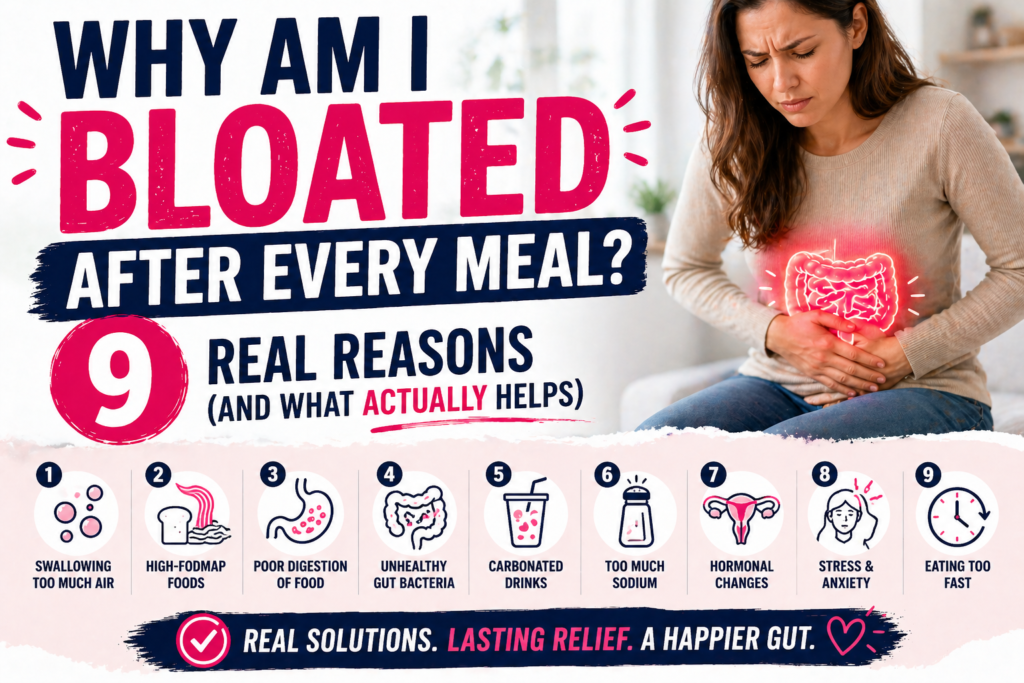
If you’re bloated after every single meal no matter what you eat, there’s a reason — usually more than one. Here’s what’s actually causing it and how to fix it for good.
If You’re Bloated After Every Single Meal, This Is Probably Why
You finish eating and within the hour your stomach is distended, uncomfortable, and you feel like you swallowed a balloon. It happens after breakfast. It happens after lunch. It happens after dinner. It doesn’t seem to matter what you eat or how much — the bloating just shows up like clockwork.
You’ve probably Googled this before. Maybe you’ve tried cutting gluten. Or dairy. Or eating smaller portions. Maybe you’ve even tried probiotics and felt like they didn’t do much. And you’re still here, still bloated, still wondering what’s actually going on inside your body.
Here’s what most articles about bloating don’t tell you: bloating after every meal is almost never just one thing. There are usually two or three overlapping causes working together — and until you address all of them, you’re going to keep feeling this way no matter what you eat.
This article is going to walk you through all of them — in plain language, with real solutions. Not vague advice about eating slower or drinking more water. Actual specific reasons your body is doing this, and what actually helps.

If you want to skip ahead to the supplement we found most effective for post-meal bloating: read our Zenwise Digestive Enzymes review or 👉 check the current price on Amazon here.
First: Understanding What Bloating Actually Is
Bloating is the sensation of fullness, pressure, or distension in your abdomen — often accompanied by visible swelling. It’s caused by excess gas or air in your digestive tract, or by your intestines being more sensitive to normal amounts of gas than they should be.
The key word is excess. Every healthy digestive system produces gas. That’s completely normal. The problem is when the amount of gas being produced is significantly higher than normal — or when your gut is so sensitized that even normal gas volumes feel uncomfortable and painful.
Both of these situations have specific, addressable causes. And understanding which one applies to you is the first step to actually fixing it rather than just managing it.

Reason #1: Your Body Isn’t Producing Enough Digestive Enzymes
This is the most commonly overlooked cause of chronic post-meal bloating — and for a lot of people reading this, it’s the primary one.
Your body produces digestive enzymes to break food down as it moves through your stomach and small intestine. Amylase for carbohydrates. Lipase for fats. Protease for proteins. Lactase for dairy. When these enzymes are doing their job properly, food gets broken down into small molecules that your body absorbs efficiently — and very little undigested material makes it to your large intestine.
When enzyme production is insufficient, things go wrong fast. Food arrives in your large intestine partially digested. The bacteria living there — which are supposed to get very little to work with — suddenly have a feast. They ferment that undigested food. Fermentation produces gas. Gas causes bloating.
What makes this particularly insidious is that enzyme production declines naturally with age. If you’re over 35 or 40 and your digestion has gradually gotten worse over the years — foods that never bothered you before now cause problems, meals hit harder, bloating is more frequent — this is almost certainly a factor.
Stress also suppresses enzyme production significantly. Chronic stress puts your body in a state where digestion is literally deprioritized. If you eat most of your meals while stressed, distracted, or rushing — and most of us do — your enzyme output during those meals is lower than it should be.
The fix is straightforward: a broad-spectrum digestive enzyme supplement taken at the start of every meal. Something like Zenwise Health Digestive Enzymes covers amylase, protease, lipase, lactase, bromelain, and papain — plus includes a probiotic strain and prebiotic. For people whose bloating is primarily enzyme-driven, the difference is often noticeable within the first few days.
👉 Check the current price of Zenwise on Amazon
Signs enzyme deficiency is your main issue:
- Bloating consistently worse after carb-heavy, fatty, or protein-heavy meals
- Dairy causes predictable, severe symptoms
- You feel better after meals when you eat very small amounts
- Digestion has gotten gradually worse with age
- You sometimes see undigested food in your stool
Reason #2: Your Gut Bacteria Are Out of Balance
Your gut contains somewhere between 38 and 100 trillion bacteria. The balance of those bacteria — how many beneficial strains versus gas-producing harmful strains — directly determines how much gas your gut produces during digestion.
A healthy, diverse microbiome processes food efficiently and produces relatively little gas. A disrupted microbiome — weighted toward harmful, gas-producing bacteria — ferments food aggressively and produces far more gas than your gut can comfortably handle.
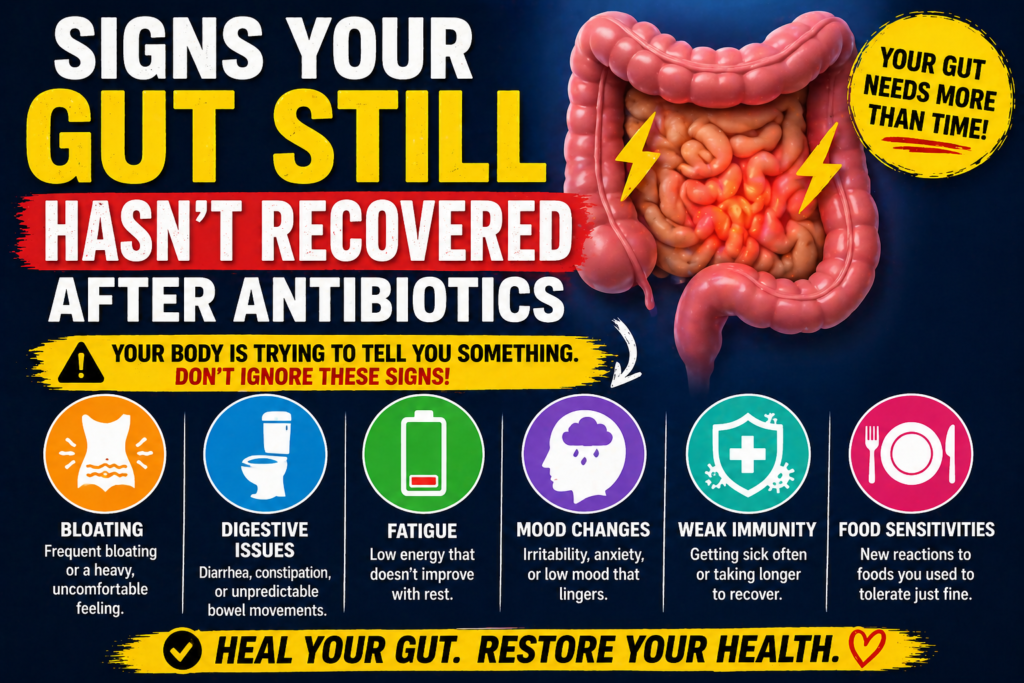
This disruption is extremely common. Antibiotics — even a single course — can significantly shift the bacterial balance in your gut in ways that persist for weeks or months. A diet high in sugar and ultra-processed foods feeds harmful bacteria at the expense of beneficial ones. Chronic stress alters the microbiome directly. And if you’ve had any kind of gastrointestinal illness, food poisoning, or gut infection, the fallout can last long after the acute illness is resolved.
The most telling sign that bacterial imbalance is driving your bloating is that it’s relatively constant — present regardless of what you eat, not specifically tied to certain food types. If you’re bloated after every meal whether you eat chicken and vegetables or pasta and cheese, the common denominator is your gut environment, not any particular food.
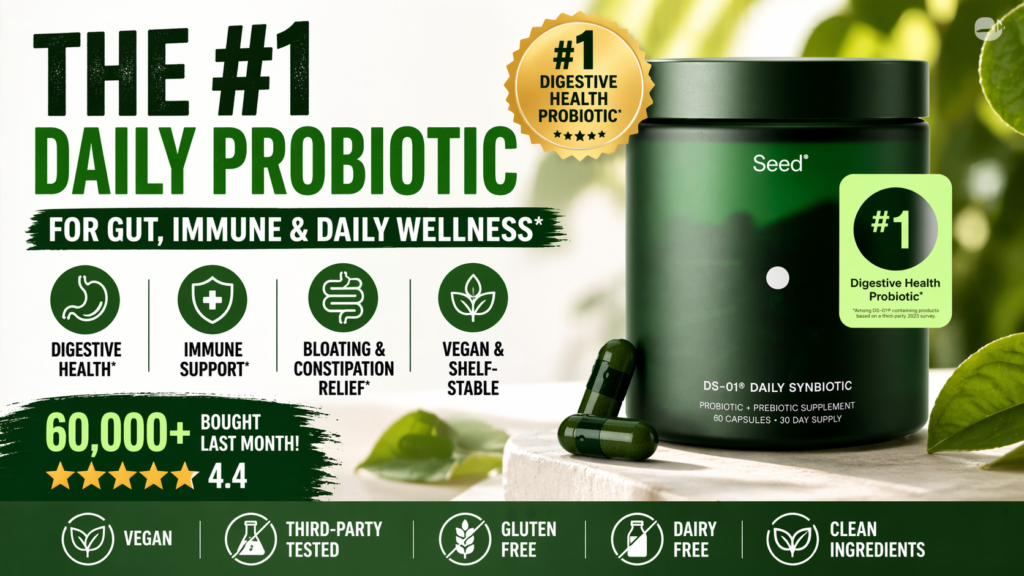
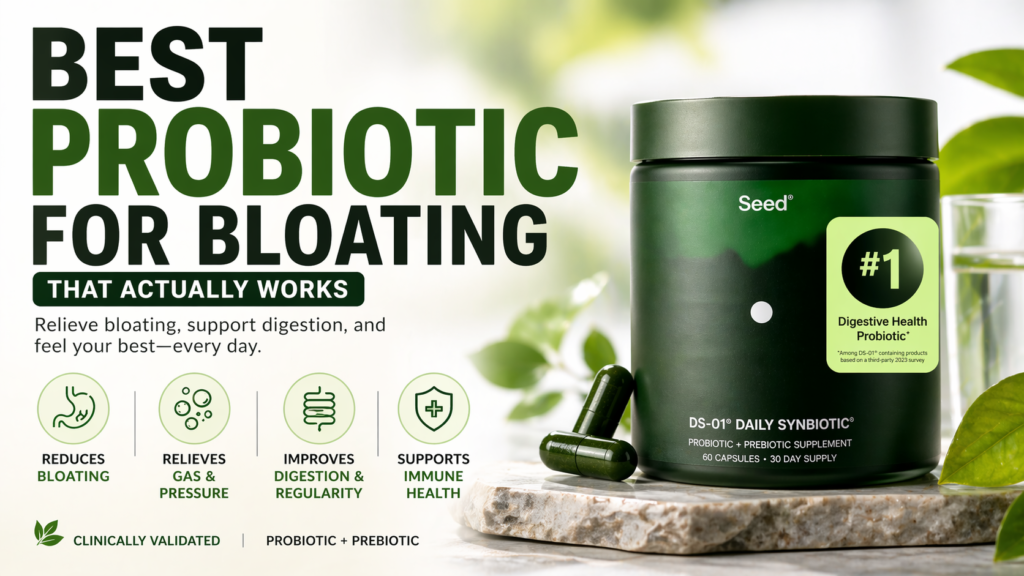
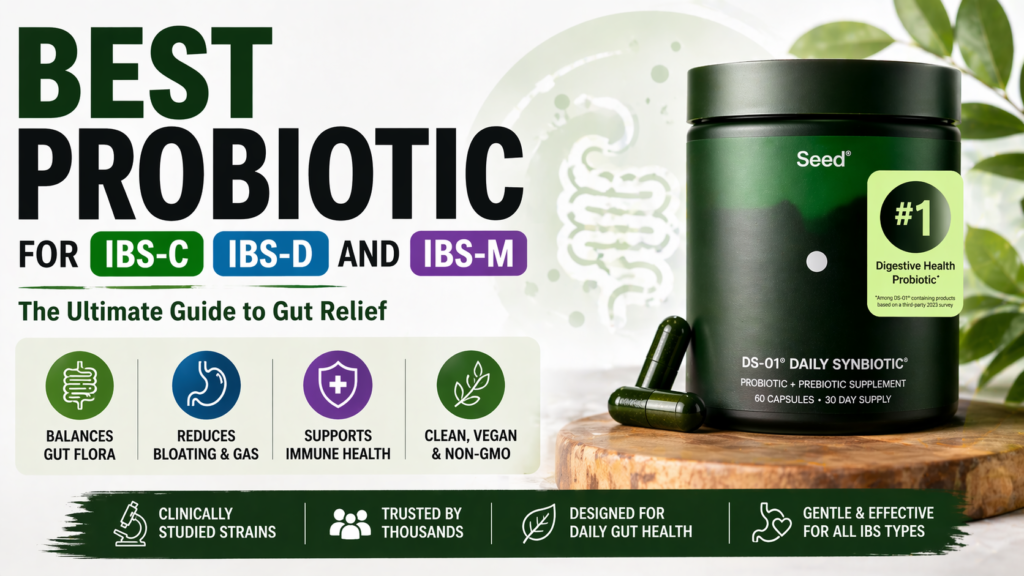
The solution here is a quality multi-strain probiotic taken consistently over 60–90 days. Not the cheap grocery store variety — those typically contain one or two weakly studied strains that survive stomach acid poorly. A product like Seed DS-01 — 24 clinically studied strains in an acid-resistant synbiotic capsule — is what actually moves the needle on a significantly disrupted microbiome.
👉 Check the current price of Seed DS-01 on Amazon
Signs bacterial imbalance is your main issue:
- Bloating is constant — not tied to specific foods
- You’ve taken antibiotics recently and digestion has been off since
- Your diet is high in sugar and processed foods
- You also experience irregular bowel movements, fatigue, or skin issues
- You’ve had a stomach bug or food poisoning in the past year

Reason #3: You’re Eating Foods High in FODMAPs
FODMAPs — Fermentable Oligosaccharides, Disaccharides, Monosaccharides, and Polyols — are a group of carbohydrates that are poorly absorbed in the small intestine and highly fermentable by gut bacteria. For people with IBS or a disrupted microbiome, high-FODMAP foods are a major bloating trigger.
The list of high-FODMAP foods is longer than most people expect. Garlic and onions are at the top — and they’re hidden in almost every savory dish, sauce, and seasoning mix. Apples, mangoes, and certain other fruits. Wheat and most bread products. Beans and lentils. Dairy. Cauliflower, mushrooms, and a range of other vegetables.
If your bloating is specifically tied to meals — and you can trace it back to dishes containing these ingredients — FODMAP sensitivity is likely a significant factor. You don’t necessarily need to follow a strict low-FODMAP diet permanently, but identifying your personal trigger foods and reducing them can make a dramatic difference.
The good news: digestive enzymes that include alpha-galactosidase help break down the complex sugars in beans and vegetables that cause the most FODMAP-related gas. Lactase helps with dairy. And a healthy microbiome — supported by a good probiotic — is better equipped to handle FODMAPs without going into full fermentation overdrive.
Common high-FODMAP bloating triggers:
- Garlic and onions (in everything — sauces, soups, seasonings)
- Beans, lentils, and chickpeas
- Wheat bread and pasta
- Apples, pears, mangoes, and watermelon
- Dairy (lactose-containing)
- Cauliflower, mushrooms, and artichokes
- Sugar alcohols (xylitol, sorbitol — found in many sugar-free products)
Reason #4: You’re Swallowing Too Much Air
This one sounds too simple to be real — but it’s a genuine and surprisingly significant cause of post-meal bloating for a lot of people. The medical term is aerophagia, and it refers to swallowing excess air while eating or drinking.
Eating quickly is the biggest culprit. When you eat fast, you swallow air with every bite. Drinking through straws does the same thing. Chewing gum throughout the day introduces more air than most people realize. Carbonated drinks are essentially liquid air — you’re directly swallowing gas every time you drink them.
That swallowed air has to go somewhere. Some of it gets burped up. The rest travels down into your intestines where it contributes to bloating and gas. If your bloating is worst right after eating — before there’s even been time for fermentation — swallowed air may be a major component.
The fix requires no supplements. Slow down when you eat. Put your fork down between bites. Cut out carbonated drinks if bloating is severe. Avoid straws. Don’t talk excessively while chewing. These changes cost nothing and can make a noticeable difference within days.



Reason #5: Your Gut Motility Is Slow
Gut motility refers to how quickly food and gas move through your digestive tract. When motility is good, food moves efficiently and gas passes through without accumulating. When motility is slow — a condition sometimes called gastroparesis in its more severe form, but more commonly just sluggish digestion — food and gas sit in your digestive tract longer than they should, creating that prolonged bloated feeling that can last for hours after eating.
Slow motility can be caused by several things. Hypothyroidism is one — low thyroid function slows down virtually every metabolic process including digestion. Diabetes can cause gastroparesis. But far more commonly, slow motility is caused by a disrupted gut microbiome, low fiber intake, chronic dehydration, or a sedentary lifestyle.
Certain probiotic strains — particularly Bifidobacterium species — have been specifically studied for their ability to improve gut motility. Getting more dietary fiber feeds the beneficial bacteria that help regulate transit time. Even moderate regular exercise has been shown to meaningfully improve gut motility.
Signs slow motility is contributing to your bloating:
- Bloating that gets progressively worse throughout the day
- You feel full for a very long time after eating
- Constipation is a regular issue
- Bloating is significantly worse on days when you’re less active
Reason #6: You Have Undiagnosed Food Intolerances
Food intolerances — not to be confused with food allergies — are extremely common and very frequently undiagnosed. The most well-known is lactose intolerance, but there are others that fly under the radar far more often.
Lactose intolerance is present in a significant portion of adults worldwide. If dairy consistently causes bloating, gas, or diarrhea, you may produce insufficient lactase to digest it properly. This is distinct from a dairy allergy — it’s purely a digestive enzyme issue, and lactase supplements handle it effectively.
Fructose malabsorption is less widely known but very common. Some people can’t absorb fructose efficiently in the small intestine — it passes to the large intestine where bacteria ferment it heavily. Apples, honey, high-fructose corn syrup, and many fruits are the main sources.
Non-celiac gluten sensitivity is a real condition distinct from celiac disease. People with this sensitivity don’t have the intestinal damage that celiac causes, but they do experience significant digestive distress — including bloating — after eating gluten. If you’ve never been tested for celiac but suspect gluten is a trigger, it’s worth discussing with your doctor.
Histamine intolerance is a lesser-known but legitimate cause of post-meal bloating and digestive distress. Histamine is found in aged cheeses, fermented foods, wine, certain fish, and processed meats. Some people lack sufficient diamine oxidase — the enzyme that breaks down histamine — and react with bloating, headaches, and flushing after eating high-histamine foods.
Reason #7: Chronic Stress Is Wrecking Your Digestion
The gut-brain connection is one of the most well-established relationships in medicine — and one of the most underappreciated by people dealing with chronic digestive issues.
Your gut and brain communicate constantly through the vagus nerve and a network of neurotransmitters. When you’re under chronic stress, your body operates in a low-grade fight-or-flight state. In that state, your nervous system deprioritizes digestion — diverting blood flow and resources away from your digestive tract and toward the muscles and systems needed to deal with a perceived threat.
The practical result is measurably impaired digestion. Enzyme secretion decreases. Gut motility slows. The gut lining becomes more permeable. The microbiome shifts toward a less healthy composition. All of these things contribute directly to bloating and digestive discomfort.
If you notice your digestion is consistently worse during stressful periods — during work deadlines, relationship conflict, or high-anxiety situations — stress is directly affecting your gut. This doesn’t mean the bloating is “in your head.” The physiological mechanism is real and well documented. It means managing your stress response is a legitimate part of treating your digestive symptoms.
Practical things that help: eating in a calm environment without screens, taking a few slow deep breaths before meals (this activates the parasympathetic nervous system and literally improves enzyme secretion), regular moderate exercise, and adequate sleep. None of these are revolutionary. All of them work.
Reason #8: Small Intestinal Bacterial Overgrowth (SIBO)
SIBO is a condition where bacteria — which normally live primarily in the large intestine — overgrow into the small intestine where they don’t belong. When this happens, food gets fermented much earlier in the digestive process than it should be, producing gas in a place where your body can’t easily expel it.
The result is bloating that can be severe, onset rapidly after eating, and accompanied by abdominal distension that is genuinely visible. SIBO is more common than many people realize and is frequently misdiagnosed as IBS — the symptoms overlap significantly.
If your bloating is severe, starts within minutes of eating rather than an hour, and is accompanied by significant visible distension and chronic irregularity, SIBO is worth investigating with your doctor through a hydrogen breath test. This is one situation where the underlying cause needs to be confirmed before a treatment protocol makes sense.
That said, digestive enzyme supplementation and probiotic use are often part of the management approach for SIBO once it’s been identified and addressed — they help restore normal digestive function and maintain the bacterial balance that prevents recurrence.
Reason #9: You’re Eating Too Fast and Too Much at Once
Your stomach is roughly the size of your fist when empty. It stretches to accommodate food — but there are limits. When you eat a very large meal very quickly, you’re asking your digestive system to process more food than it can handle efficiently in one sitting.
The enzyme capacity of your stomach and small intestine is finite. Flood it with more food than it can handle enzymatically, and some of that food will inevitably pass through partially digested. Combine that with swallowed air from eating quickly, and you have a recipe for significant post-meal bloating that has less to do with what you ate and more to do with how and how much.
Smaller, more frequent meals reduce the demand placed on your digestive system at any one time. Slowing down and chewing thoroughly gives your body’s own enzymes more time to work before food moves to the next stage of digestion. These aren’t exciting fixes — but they work, and they amplify the benefits of any supplement you’re also taking.
The Most Effective Fix: Addressing Multiple Causes Simultaneously
Here’s the truth about chronic bloating after every meal: if it’s happening consistently regardless of what you eat, how much you eat, or what time of day it is, there’s almost certainly more than one cause at work. The people who try one thing — cutting gluten, trying one probiotic, eating smaller meals — and don’t see results usually haven’t addressed the full picture.
The most effective approach combines:
- Digestive enzymes with every meal to ensure proper food breakdown regardless of your body’s current enzyme output. Our top pick: Zenwise Health Digestive Enzymes — 👉 check the price on Amazon
- A quality multi-strain probiotic daily to rebalance the gut bacteria driving fermentation and gas. Our top pick: Seed DS-01 Daily Synbiotic — 👉 check the price on Amazon
- Identifying and reducing your personal FODMAP triggers — not necessarily eliminating them forever, but reducing the load while your gut heals
- Slowing down at meals — no screens, fewer large meals, more thorough chewing
- Managing stress — especially around mealtimes
You don’t have to implement all of this at once. Start with the enzymes — they give the fastest relief and tell you quickly whether enzyme deficiency is a major factor for you. Add the probiotic for the longer-term bacterial work. Then layer in the dietary and lifestyle adjustments as you go.
How Long Until the Bloating Actually Gets Better?
This depends on which causes are driving your symptoms and how many of them you’re addressing.
If enzyme deficiency is the primary issue, many people notice meaningful improvement within the first week of consistent enzyme supplementation. Digestive enzymes work immediately — every meal where you take them is a meal where food gets broken down better.
If bacterial imbalance is the main driver, the timeline is longer. Probiotic results take 2–4 weeks to become clearly noticeable and 60–90 days of consistent daily use for the full benefit to develop. The bacteria are shifting slowly — but the shift is real and lasting.
For most people with chronic post-meal bloating, the sweet spot is 4–6 weeks of consistent enzyme plus probiotic use combined with some dietary adjustments. By that point, most people have a dramatically clearer picture of what’s actually driving their symptoms — and most have experienced meaningful improvement.
When to See a Doctor
Most bloating, even chronic bloating, is not dangerous. But there are situations where it warrants medical evaluation rather than self-treatment.
See your doctor if:
- Bloating is accompanied by unexplained weight loss
- You have persistent or severe abdominal pain alongside bloating
- There is blood in your stool
- Bloating has come on suddenly and severely with no clear cause
- You have a family history of colon cancer or inflammatory bowel disease
- Symptoms are getting progressively worse over weeks despite dietary changes
These can be signs of conditions that require medical diagnosis — celiac disease, inflammatory bowel disease, colorectal issues — rather than supplementation and lifestyle changes. When in doubt, get checked out. Most of the time you’ll come back with reassurance and a better starting point for addressing the issue. But it’s always worth ruling out the serious stuff.
Frequently Asked Questions
Why am I bloated after every meal no matter what I eat?
Constant post-meal bloating regardless of what you eat usually points to one of two things: enzyme deficiency (your body isn’t breaking food down properly) or bacterial imbalance (your gut microbiome is producing excess gas during fermentation). Many people have both simultaneously. Addressing both with a digestive enzyme supplement and a quality probiotic is the most effective approach.
Is it normal to be bloated after every meal?
No — some mild fullness after eating is normal, but significant bloating, distension, discomfort, or gas after every meal is not. It’s a sign something in your digestive process isn’t working optimally and is worth addressing rather than accepting as normal.
What is the fastest way to relieve bloating after eating?
In the immediate moment: gentle movement (a short walk helps move gas through your system), peppermint tea which relaxes the intestinal muscles and helps gas pass, and lying on your left side if resting. For longer-term relief starting from the next meal, a digestive enzyme supplement taken at the beginning of every meal is the fastest-acting intervention.
Can digestive enzymes stop bloating after meals?
For a large proportion of people, yes — especially if enzyme deficiency is the primary cause. A comprehensive enzyme supplement like Zenwise ensures food gets properly broken down before it reaches the gas-producing bacteria in your colon. Many people notice a clear difference within the first few meals. Read our full Zenwise review here.
Do probiotics help with bloating after every meal?
Yes — but they work more slowly than enzymes. A quality probiotic addresses the bacterial imbalance that causes excess fermentation and gas production. Results typically become noticeable at 2–4 weeks and continue improving through 60–90 days of daily use. Our top recommendation is Seed DS-01.
Does bloating after every meal mean I have IBS?
Not necessarily — though IBS is one of the conditions that causes chronic post-meal bloating. Many people bloat consistently after meals without having IBS — enzyme deficiency, FODMAP sensitivity, and bacterial imbalance can all produce the same symptoms in people without an IBS diagnosis. That said, if your bloating is accompanied by significant irregularity, cramping, and urgency, discussing IBS with your doctor is worth doing.
What foods cause the most bloating after meals?
The biggest culprits are high-FODMAP foods: onions and garlic, beans and lentils, cruciferous vegetables like broccoli and cauliflower, wheat products, dairy (for those with lactose intolerance), and certain fruits like apples and pears. Carbonated drinks contribute through swallowed gas. Fatty foods slow gastric emptying and can cause prolonged bloating. Identifying your personal worst offenders is more useful than eliminating everything on the general list.
Can stress cause bloating after every meal?
Yes — and significantly so. Chronic stress impairs enzyme secretion, slows gut motility, disrupts the microbiome, and increases gut sensitivity. If your bloating is consistently worse during stressful periods, managing your stress response is a legitimate and effective part of addressing your digestive symptoms.
How do I know if my bloating is from enzymes or bacteria?
A useful rough distinction: if your bloating is specific to certain foods or meal types (carbs, dairy, fatty meals), enzyme deficiency is more likely the primary driver. If your bloating is constant regardless of what you eat, bacterial imbalance is more likely the main issue. Many people have both — which is why addressing both simultaneously gives the best results.
You Don’t Have to Live Like This
Bloating after every meal is miserable. It affects how you dress, how you feel about your body, what you’re willing to eat, whether you want to go out after dinner, how much energy you have for the rest of your day. It’s not a minor inconvenience — for a lot of people it’s a daily quality of life issue that colors everything.
The frustrating part is that for most people, it’s fixable. Not overnight, and not with one simple thing — but with the right combination of targeted support addressing the actual causes, the bloating that feels permanent and inevitable is usually very much not.
Start with digestive enzymes for immediate meal-by-meal improvement. Add a quality probiotic for the longer-term bacterial work. Reduce your highest-impact FODMAP triggers. Slow down when you eat. Give it 60 days of consistency.
Your gut can work the way it’s supposed to. It just needs the right support to get there.
👉 Try Zenwise Digestive Enzymes on Amazon — our top pick for immediate post-meal bloating relief.
👉 Try Seed DS-01 on Amazon — our top pick for long-term gut bacteria rebalancing.
More from TummyCure:
- Zenwise Digestive Enzymes — Full Review
- Seed DS-01 — Full Probiotic Review
- Best Digestive Enzymes for Bloating
- Best Probiotic for Bloating That Actually Works
- Digestive Enzymes vs Probiotics — Do You Need Both?
- 8 Signs Your Body Needs Digestive Enzymes
- Do Digestive Enzymes Help IBS?
- How to Get Rid of That Heavy Feeling in Your Stomach
- Is Everything You’ve Heard About Gut Health Wrong?
About the Author
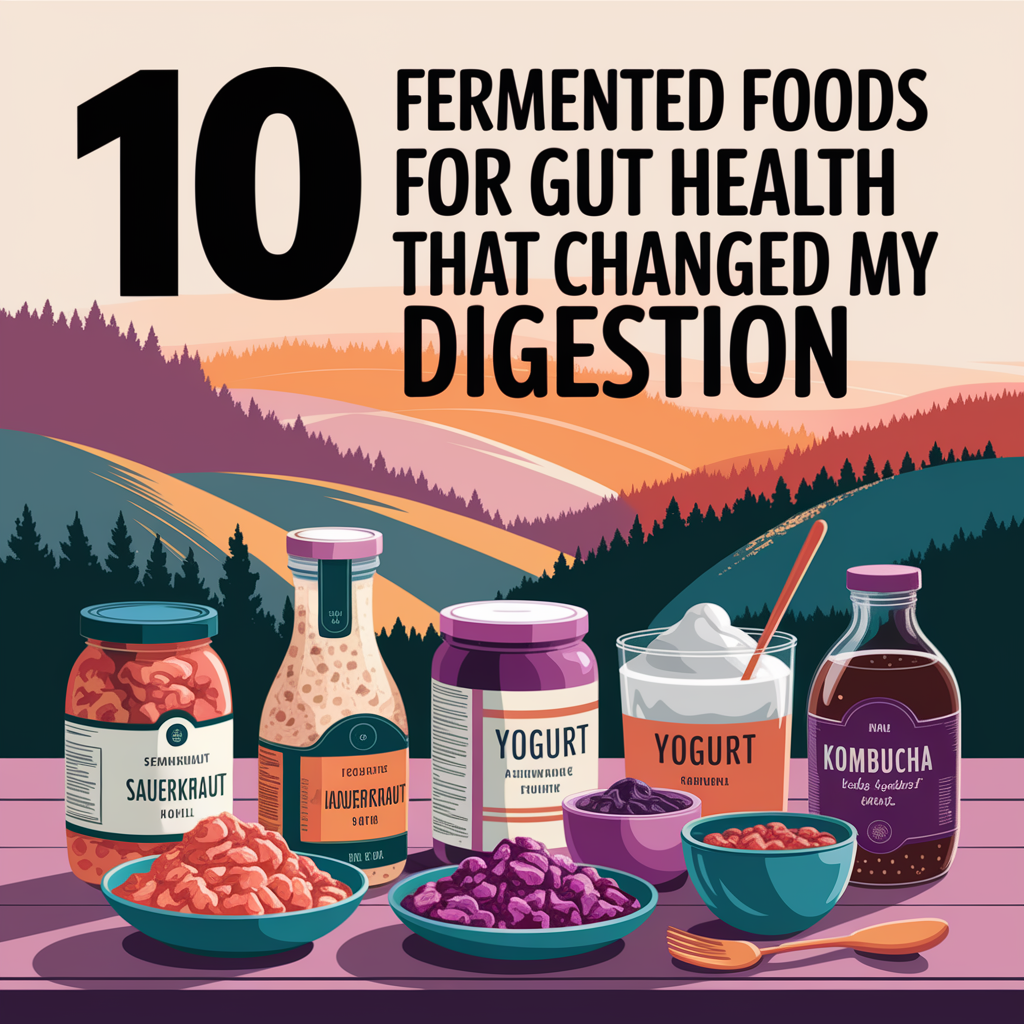
Rachel Donnelly is a certified nutritional health coach and gut health writer who spent years struggling with IBS and bloating before making digestive wellness her specialty. She writes for TummyCure with one goal: cut through the noise and tell you what actually works. When she’s not deep in microbiome research, she’s fermenting things in her kitchen and losing arguments with her husband about whether kombucha counts as a dessert.
As an Amazon Associate we earn from qualifying purchases through some links in our articles.