Psyllium husk has more clinical evidence behind it than almost any other gut supplement. Here’s why it works, what the research shows, and why the capsule format finally makes it easy to use.
The Oldest Gut Health Remedy on Earth Still Outperforms Most Modern Supplements
Psyllium husk has been used for digestive health for thousands of years. And in an industry full of overhyped new ingredients with minimal research behind them, psyllium stands out for exactly the opposite reason — it has more clinical evidence behind it than almost any other fiber supplement on the market. Multiple meta-analyses, decades of research, and consistent results across tens of thousands of study participants.
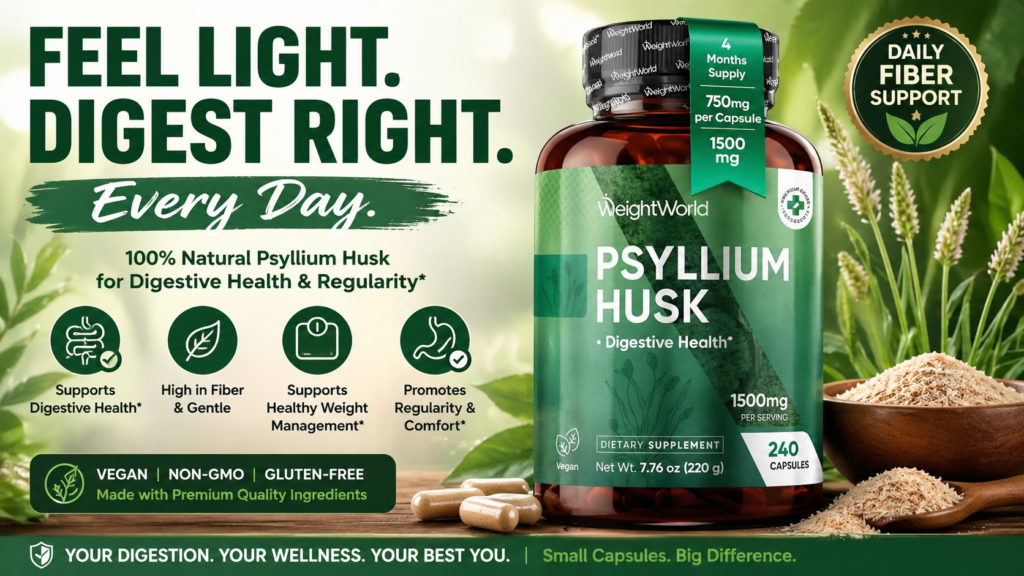
What’s changed is the delivery format. WeightWorld’s psyllium husk capsules give you 1500mg per serving in a convenient vegan capsule — no gritty powder to choke down, no mixing required, just consistent daily fiber support that your gut bacteria, your bowel movements, and your cholesterol levels will all thank you for.
👉 Check the current price on Amazon — Psyllium Husk Capsules 1500mg
What Psyllium Husk Actually Is
Psyllium is the seed husk of Plantago ovata — a plant native to India and the Mediterranean. The husks are almost entirely soluble fiber, which means they dissolve in water to form a viscous gel. That gel is what makes psyllium so effective — it bulks and softens stool for constipation relief, slows digestion to improve satiety, feeds beneficial gut bacteria as a prebiotic, and forms a soothing coating over irritated intestinal walls.
The soluble fiber in psyllium is one of the few dietary fibers that produces benefits for both constipation and diarrhea — which makes it uniquely useful for people with IBS-M (mixed type) who alternate between the two. It normalizes rather than simply accelerating or slowing — a distinction that matters enormously for people whose gut symptoms are inconsistent.
The Research Is Genuinely Impressive
Psyllium is one of the most researched fiber supplements in existence. Here’s what the evidence consistently shows:
For constipation: Psyllium increases stool frequency, softens stool consistency, and reduces straining — consistently and significantly across multiple clinical trials. It works more gently and consistently than stimulant laxatives without causing dependency or urgency.
For IBS: Multiple randomized controlled trials have shown psyllium significantly reduces IBS symptom severity — particularly abdominal pain, bloating, and irregularity. A landmark study published in the British Medical Journal found psyllium was significantly more effective than bran for IBS symptom relief. This is one of the most robust evidence bases for any supplement in the gut health space.
For cholesterol: The FDA has approved a health claim for psyllium and heart disease — the evidence for its cholesterol-lowering effects is strong enough to meet that regulatory bar. The soluble fiber binds bile acids in the intestine, reducing their reabsorption and forcing the liver to use cholesterol to make more bile.
For blood sugar: Psyllium slows the absorption of glucose from meals, reducing post-meal blood sugar spikes. This is particularly relevant for people with insulin resistance or type 2 diabetes.
Why the Capsule Format Matters
If you’ve ever tried mixing psyllium husk powder into water you know the challenge — you have about 30 seconds before it turns into a thick gel that’s genuinely unpleasant to drink. The capsule format eliminates this entirely. You take two capsules with a full glass of water and you’re done.
The 1500mg per serving in this formula is a solid daily fiber dose — not massive, but consistent. For people who already eat a reasonable amount of dietary fiber, this provides meaningful additional support without causing the digestive adjustment symptoms that can come from suddenly tripling your fiber intake. For people on lower fiber diets, you may want to build up gradually — adding psyllium to an already very low fiber diet too quickly can temporarily increase gas and bloating as your gut bacteria adjust.
The four-month supply at 240 capsules also makes this an excellent value — this is a supplement that works best taken consistently over months rather than cyclically, and the supply quantity encourages that consistency.
How Psyllium Works With Your Gut Bacteria
This is the aspect of psyllium that most people don’t know about — and it’s one of the most compelling reasons to take it if gut health is your primary goal.
Psyllium husk is a prebiotic — meaning it feeds and supports the growth of beneficial gut bacteria. Specifically, it’s fermented by beneficial strains including Bifidobacterium and Lactobacillus species, producing short-chain fatty acids — particularly butyrate — that are the primary fuel source for the cells lining your colon.
Butyrate is genuinely remarkable. It maintains the integrity of the gut lining, reduces intestinal inflammation, supports the immune system living in and around your gut, and appears to reduce the risk of colorectal cancer with long-term adequate intake. Getting more butyrate from fiber fermentation is one of the most evidence-backed things you can do for long-term gut health.
This prebiotic effect also means psyllium works synergistically with probiotic supplements. The probiotics introduce beneficial bacteria — the psyllium gives those bacteria the food they need to thrive and multiply. If you’re taking a probiotic like Seed DS-01, adding psyllium creates a genuinely more complete gut health system. Understanding how prebiotics and probiotics work together puts this combination in proper context.
Who Will Benefit Most
- People with IBS — particularly IBS-C or IBS-M — looking for evidence-backed fiber support
- Anyone dealing with chronic constipation who wants a gentle, non-laxative solution
- People who know they don’t eat enough fiber but struggle with powder-format supplements
- Anyone wanting to support their gut microbiome with a reliable prebiotic source
- People concerned about cholesterol or blood sugar alongside gut health
- Those recovering gut health after antibiotics who need prebiotic fiber to feed rebuilding beneficial bacteria
If you’ve recently taken antibiotics and are working on restoring your gut bacteria, psyllium husk is one of the most valuable additions you can make alongside a quality probiotic.
How to Take It for Maximum Benefit
Always take psyllium with a full large glass of water — this is non-negotiable. The fiber needs water to form its gel properly. Taking it without adequate water can cause it to swell in the esophagus, which is deeply unpleasant and occasionally dangerous. Two capsules, large glass of water, done.
Timing is flexible — before meals works well for blood sugar and satiety benefits, with meals or between meals works well for constipation and IBS. Most people find before their largest meal is the most convenient single daily timing.
Start with one capsule per day for the first week if you’re not currently eating much fiber — then move to two. This gradual increase minimizes the temporary gas and bloating that comes from rapidly increasing fiber intake for people whose gut bacteria haven’t been fermenting much fiber previously.
The Bottom Line
Psyllium husk is one of the most evidence-backed supplements in existence for gut health — and the capsule format makes it easy enough to actually use consistently. For IBS, constipation, microbiome support, and a range of benefits well beyond digestion, this is a supplement with a decades-long track record that newer ingredients simply can’t match.
The four-month supply at this price point makes the value case straightforwardly good. This is a daily supplement, not a cyclical one — and the supply quantity is right for how it should be used.
👉 Check the current price of Psyllium Husk Capsules on Amazon
Related reading:
- Best Probiotic for IBS-C, IBS-D and IBS-M
- Seed DS-01 — Our Top Probiotic Pick
- Digestive Enzymes vs Probiotics — Do You Need Both?
- How to Restore Gut Bacteria After Antibiotics
- Why Am I Bloated After Every Meal?
- 8 Signs Your Gut Desperately Needs a Probiotic
About the Author
James Whitfield is a registered dietitian and fiber evangelist who has spent the better part of a decade trying to convince people that the most boring supplement on the shelf is also one of the most powerful. After years of clinical work in gastroenterology, he now writes about evidence-based nutrition with a focus on cutting through the supplement industry noise. He lives in Portland, Oregon, runs embarrassingly slowly, and has strong opinions about the fiber content of everything he eats.
As an Amazon Associate we earn from qualifying purchases through some links in our articles.