Your gut lining is made of collagen. Here’s why collagen peptides are one of the most overlooked gut health supplements — and what five types of hydrolyzed collagen actually does for digestion and skin.
Your Gut Lining Needs Building Blocks — Collagen Peptides Might Be the Ones It’s Missing
Collagen gets most of its attention in the beauty and fitness world — skin elasticity, joint recovery, hair and nails. But there’s a gut health angle to collagen peptides that deserves far more attention than it gets, and it’s one of the more compelling emerging areas of gut health research.
The lining of your gut is largely made of collagen. The tight junctions between intestinal cells that keep your gut barrier intact — preventing undigested food particles, bacteria, and toxins from leaking into your bloodstream — depend on collagen for their structure and integrity. When that collagen is depleted or degraded, the gut barrier weakens. When the gut barrier weakens, you have the condition increasingly known as leaky gut — increased intestinal permeability that’s associated with chronic inflammation, food sensitivities, autoimmune conditions, and systemic symptoms that seem completely unrelated to your digestion.
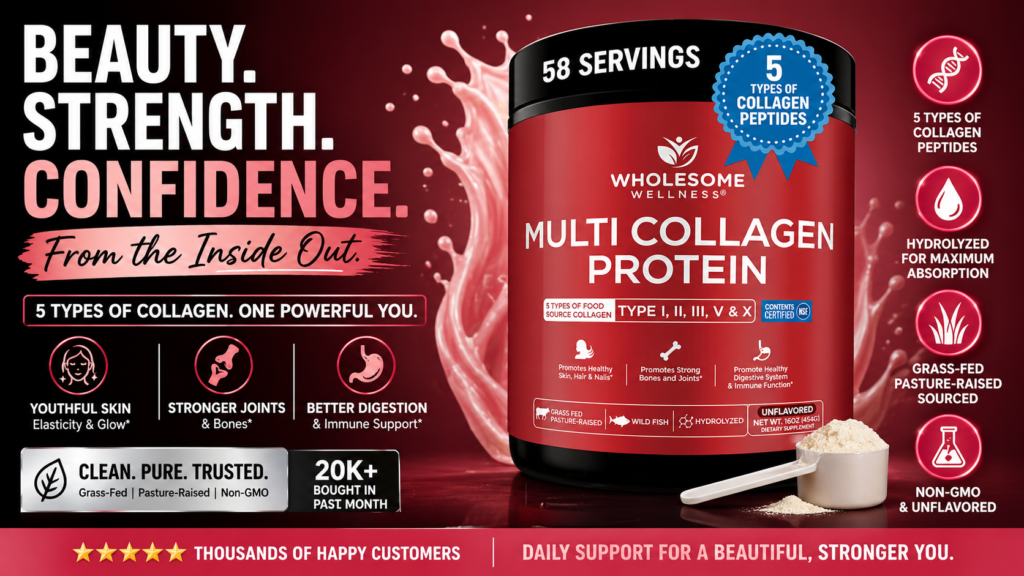
Wholesome Wellness Multi Collagen Peptides gives you five types of hydrolyzed collagen from grass-fed sources — unflavored, non-GMO, and designed to mix seamlessly into any liquid or food.
👉 Check the current price on Amazon — Multi Collagen Peptides Powder
The Gut Lining Connection Most People Don’t Know About
Your intestinal lining is one of the most metabolically active tissues in your body. It turns over completely approximately every five to seven days — the cells of the gut lining are constantly being shed and replaced. This rapid turnover requires a constant supply of building materials, and collagen is one of the most important.
The structural proteins in the gut lining — type I, III, and IV collagen specifically — maintain the mechanical integrity of the intestinal wall and the tight junctions between cells. When collagen availability is inadequate, the gut lining’s ability to maintain these tight junctions is compromised. The resulting increased permeability allows partially digested food particles and bacterial toxins to cross into the bloodstream, triggering immune responses that manifest as food sensitivities, systemic inflammation, skin problems, joint pain, and a range of symptoms that seem disconnected from gut health but frequently aren’t.
This is why collagen peptides have become part of the gut health conversation — not as a direct treatment for any specific gut condition, but as structural support for the gut lining that underlies much of what goes wrong in chronic gut problems. The connection between gut lining integrity and skin health is a perfect example of how collagen’s gut benefits show up in unexpected places.
Why Five Types of Collagen Matter
Most collagen supplements contain only type I — bovine collagen from hides. Wholesome Wellness Multi Collagen includes five types:
Type I — the most abundant in the body, found in skin, tendons, bone, and the gut lining. Essential for structural integrity of the intestinal wall.
Type II — found primarily in cartilage. Most relevant for joint health but also present in connective tissue throughout the gut.
Type III — found alongside type I in the gut, blood vessels, and skin. Important for gut lining repair and flexibility.
Type IV — found in the basement membrane of the intestinal lining — the layer directly beneath the cells. Critical for gut barrier function specifically.
Type V — found in cell surfaces and hair. Less central to gut health but contributes to overall connective tissue quality.
For gut health specifically, types I, III, and IV are most relevant — and having all of them in one supplement is a meaningful advantage over single-type formulas.
Hydrolyzed Peptides — Why This Form Absorbs Better
Regular collagen is a very large protein molecule that doesn’t absorb efficiently from the digestive tract. Hydrolyzed collagen — also called collagen peptides — has been broken down into much smaller fragments through enzymatic processing. These smaller peptides are absorbed significantly more efficiently through the intestinal wall and appear in the bloodstream intact, where they can be used to synthesize new collagen in target tissues.
Research has consistently shown that collagen peptides specifically — rather than whole collagen — produce measurable increases in markers of collagen synthesis in skin, joints, and connective tissue. The hydrolyzed form is non-negotiable for a collagen supplement to actually work rather than just being digested like any other protein.
This formula uses fully hydrolyzed peptides — the powder dissolves completely in both hot and cold liquids, has no taste or texture, and mixes into coffee, smoothies, soups, or water with no effect on flavor.
The Skin Connection — Because Your Gut and Your Face Are More Connected Than You Think
One of the clearest ways collagen’s gut benefits manifest is in skin health — which is also one of the most researched areas for collagen supplementation. The mechanism works both directly and indirectly.
Directly: collagen peptides absorbed from the gut are used to build new collagen in the dermis — the deep layer of skin where structural integrity and elasticity originate. Multiple clinical trials have shown measurable improvements in skin elasticity, hydration, and wrinkle depth with consistent collagen peptide supplementation.
Indirectly: a stronger gut lining with better barrier function means less systemic inflammation from gut permeability — and systemic inflammation is one of the primary drivers of inflammatory skin conditions including acne, eczema, and rosacea. How gut health directly influences skin conditions covers this connection in much more detail.
How to Use It
One to two scoops per day — typically 10 to 20 grams of collagen peptides. Mix into any liquid or soft food. Coffee is the most popular vehicle — the powder dissolves completely and adds a very slight richness without any collagen flavor. Smoothies, soups, oatmeal, and yogurt all work equally well.
Take it consistently — collagen synthesis is a gradual process. Most people notice skin improvements at 4 to 8 weeks of daily use. Gut lining improvements are harder to measure directly but the systemic inflammation markers associated with leaky gut have been shown to improve with consistent collagen peptide supplementation over similar timeframes.
Collagen is most effective when taken alongside vitamin C — vitamin C is a required cofactor for collagen synthesis. If you’re not eating plenty of citrus, berries, or bell peppers, consider adding a vitamin C supplement alongside your collagen.
Where It Fits in a Complete Gut Health Stack
Collagen peptides are a structural support tool — they provide building materials for gut lining repair. They work best alongside the supplements that address the other dimensions of gut health. A quality probiotic like Seed DS-01 rebalances the bacterial communities whose health directly affects the gut lining. Digestive enzymes like Zenwise ensure food is properly broken down before it can irritate that lining. Collagen provides the structural proteins needed to keep the lining itself intact and repairing efficiently.
The complete gut health guide covers how all of these pieces fit together into a coherent daily protocol.
The Verdict
Multi Collagen Peptides isn’t a gut health product in the traditional sense — it doesn’t directly treat IBS symptoms or rebalance gut bacteria. What it does is provide structural support for the gut lining that is increasingly understood to underlie chronic gut permeability, systemic inflammation, and many of the seemingly unrelated symptoms that go alongside gut problems. The five-type formula, grass-fed sourcing, and fully hydrolyzed format make this one of the better quality options at a competitive price point.
If gut lining integrity, leaky gut concerns, skin health, or joint recovery alongside your gut health goals are part of your picture — this is worth adding to your daily routine.
👉 Check the current price of Multi Collagen Peptides on Amazon
Related reading:
- 7 Signs Your Gut Health Is Affecting Your Skin
- How Gut Health Influences Skin Conditions
- Is Your Gut Sabotaging Your Mental Health?
- Seed DS-01 — Our Top Probiotic Pick
- The Complete Gut Health Guide
- 8 Signs Your Gut Desperately Needs a Probiotic
About the Author
Priya Sharma is a nutritional biochemist turned health writer who spent six years researching connective tissue metabolism before deciding academic publishing wasn’t reaching the people who actually needed the information. She writes about the intersection of gut health, skin health, and structural nutrition — the unglamorous biochemistry behind why some supplements work and most don’t. She’s based in Chicago, drinks her collagen in her morning coffee, and is professionally obligated to point out that vitamin C matters if you actually want the collagen to be synthesized.
As an Amazon Associate we earn from qualifying purchases through some links in our articles.