
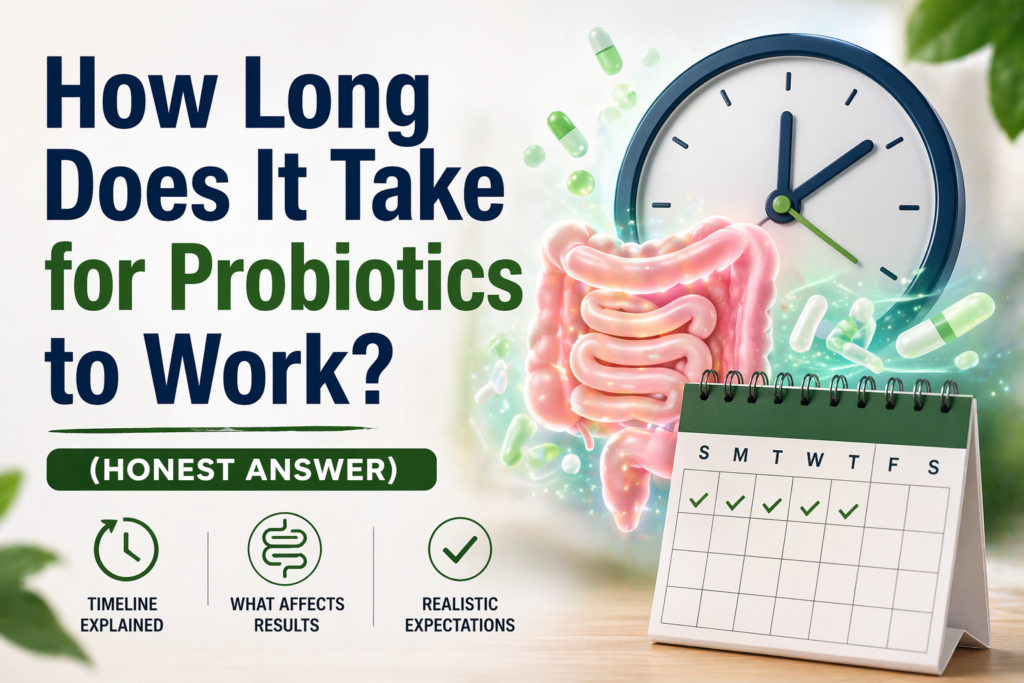
Most people quit probiotics too early. Here’s the real timeline — week by week — for bloating, IBS, regularity, and gut health.
The Honest Answer Nobody Gives You
You started taking a probiotic a week ago. You feel… about the same. Maybe a little gassy. You’re wondering if you wasted your money.
Here’s the thing — you probably didn’t. But probiotics are one of the most misunderstood supplements out there when it comes to expectations and timeline. Most people quit too early, with a product that would have actually worked if they’d given it enough time.
So let’s talk about what’s actually happening in your gut, when you should start feeling something, and what to do if you’re not.
| Timeline | What to Expect |
|---|---|
| Days 1–7 | Possible adjustment gas — gut is adapting |
| Week 2 | Early signs of improvement for some people |
| Week 3–4 | Noticeable reduction in bloating, more regularity |
| Month 2 | Sustained digestive improvement, less discomfort |
| Month 3+ | Deeper microbiome shifts, immune and energy benefits |

Why Probiotics Take Time to Work
Your gut contains somewhere between 38 and 100 trillion bacteria. You’re not going to shift that ecosystem in three days with a single capsule. What you’re doing when you take a probiotic is slowly tipping the balance — introducing more beneficial bacteria day by day until they establish enough of a presence to actually make a difference.
Think of it like planting a garden in soil that’s been neglected. You don’t plant seeds and harvest tomatoes the next morning. You plant, water consistently, and give it time to take root.
Your gut is the same. The probiotics need time to survive the journey through your stomach acid, colonize your intestines, and multiply enough to have a real impact on your symptoms.
| Factor | How It Affects Timeline |
|---|---|
| Your current gut health | More disrupted microbiome = longer to see results |
| Probiotic strain quality | Clinically studied strains work faster and more reliably |
| Delivery system | Acid-resistant capsules get more bacteria to intestines |
| Diet | High sugar/processed diet slows bacterial establishment |
| Consistency | Missing doses resets progress — daily is non-negotiable |

Week by Week: What’s Actually Happening
Days 1–7: The Adjustment Phase
This is the phase that confuses people the most. You might actually feel a little worse before you feel better. More gas, slightly more bloating — your gut is reacting to the new bacterial population being introduced. This is completely normal and almost always resolves within 5–7 days. Don’t quit here. This is the adjustment, not an allergic reaction.
Week 2: Early Signals
Some people start noticing subtle shifts around week two. Less end-of-day bloating. A more predictable bathroom schedule. More comfortable digestion after meals. These are early signs the bacteria are beginning to establish. Not everyone feels this yet — and that’s fine too. If bloating is the main concern, our guide to probiotics for bloating relief compares products by strain research and delivery system.
Weeks 3–4: The Sweet Spot
This is when most people notice something real. Bloating is reduced. Irregularity is improving. The discomfort after meals is easing up. If you were going to notice a clear difference, this is usually when it happens. This is also why one month is the minimum test window for any probiotic.
Month 2 and Beyond: The Long Game
This is where the real magic happens. Your gut microbiome is shifting in deeper, more meaningful ways. Immune function is improving. Skin may be clearer. Energy is more consistent. These benefits compound over time — and they’re the reason the best probiotic users stay on their product indefinitely rather than cycling on and off.
| Goal | Minimum Time Needed |
|---|---|
| Bloating relief | 2–4 weeks |
| Improved regularity | 3–4 weeks |
| IBS symptom reduction | 4–8 weeks |
| Immune support | 8–12 weeks |
| Full microbiome rebalance | 3–6 months |
Does the Probiotic Brand Matter?
Enormously. This is probably the biggest reason people don’t see results — they’re using a product that was never going to work well to begin with.
Here’s what separates a probiotic that works from one that doesn’t:
Clinically studied strains. Generic probiotics often contain strains that sound impressive on the label but have little to no human research behind them. You want strains like Lactobacillus rhamnosus GG, Bifidobacterium longum, and Lactobacillus acidophilus — these have real evidence. Readers looking for a multi-strain option with digestive enzymes can consider Garden of Life Raw Probiotics as one product to evaluate against these criteria.
Acid-resistant delivery. Most probiotics die in your stomach acid before they ever reach your intestines. Products with enteric coating or specialized capsule technology — like the nested capsule system in Seed DS-01 — deliver significantly more live bacteria where they actually need to go.
Prebiotic included. Bacteria need food to survive and multiply. A synbiotic (probiotic + prebiotic combined) gives bacteria what they need to actually establish in your gut rather than just passing through.
If you want our full take on the best option available right now, we put together a detailed review: Seed DS-01 Review — Is It Actually Worth $50 a Month?
Check current price of Seed DS-01 on Amazon
| Product Quality Factor | Impact on Timeline |
|---|---|
| Clinically studied strains | Faster, more predictable results |
| Acid-resistant capsule | More bacteria survive = faster colonization |
| Prebiotic included | Bacteria thrive longer, establish faster |
| High CFU count | More bacteria introduced per dose |


Signs Your Probiotic Is Working
Sometimes the signs are obvious. Sometimes they’re subtle and easy to miss if you’re not paying attention. Here’s what to watch for:
- Less bloating by end of day — especially after meals that used to be problematic
- More predictable, consistent bowel movements
- Less urgency or cramping (IBS sufferers especially)
- Reduced gas and pressure throughout the day
- Feeling lighter and less uncomfortable after eating
- Better energy — gut health and energy levels are more connected than most people realize
- Clearer skin — the gut-skin axis is real
Signs It’s Not Working (And What to Do)
If you’ve been consistent for 6–8 weeks and feel absolutely no difference, here are the most likely reasons:
Wrong strains for your issue. Not all probiotics target the same problems. If you have IBS-D and you’re taking a constipation-focused formula, don’t expect miracles. Match the product to your specific symptoms. For a strain-by-strain approach, see Choosing the right probiotic for your specific IBS type.
Poor delivery system. If your probiotic doesn’t have acid protection, a large percentage of the bacteria are dying before they reach your intestines. Switch to a product with proven delivery technology.
Inconsistency. Missing doses breaks the bacterial establishment process. Daily, every day, no exceptions.
Diet undermining the work. A high-sugar, low-fiber diet is constantly feeding the bad bacteria you’re trying to displace. The probiotic is fighting an uphill battle.
Frequently Asked Questions
How quickly do probiotics work for diarrhea?
For acute diarrhea — like from a stomach bug or antibiotics — probiotics can help within 1–3 days. For chronic diarrhea related to IBS-D, expect 4–8 weeks of consistent use for meaningful improvement.
How quickly do probiotics work for constipation?
Most people see improvement in regularity within 2–4 weeks. Bifidobacterium strains are the most studied for constipation — look for products that include them prominently.
Should I take probiotics on an empty stomach or with food?
With food. Food buffers stomach acid and protects the bacteria on their way to your intestines. First meal of the day is ideal for most people.
Can I take probiotics long term?
Yes — and you probably should if they’re working for you. Your gut microbiome is constantly under pressure from diet, stress, medications, and environment. Long-term supplementation helps maintain the balance you’ve built.
What’s the best probiotic to see results fastest?
Products with clinically studied strains, acid-resistant delivery, and a prebiotic component give you the best shot at faster results. Seed DS-01 is our top recommendation — read the full Seed DS-01 review here.
The Bottom Line
Probiotics work — but they work on gut time, not your timeline. Give it a minimum of 4 weeks before you judge, stick with it daily, and make sure you’re using a product with actual clinical research behind the strains.
Most people who say probiotics don’t work either quit too early or used the wrong product. Don’t be that person. The investment in a quality probiotic taken consistently over 60–90 days is one of the most effective things you can do for your long-term digestive health.
Try Seed DS-01 on Amazon — our top-rated pick for proven results.
Related reading on TummyCure:
- Seed DS-01 Full Review
- How to Restore Gut Bacteria After Antibiotics
- 10 Fermented Foods That Changed My Digestion
About the Author
Rachel Donnelly is a certified nutritional health coach and gut health writer who spent years struggling with IBS and bloating before making digestive wellness her specialty. She writes for TummyCure with one goal: cut through the noise and tell you what actually works. When she’s not deep in microbiome research, she’s fermenting things in her kitchen and losing arguments with her husband about whether kombucha counts as a dessert.
As an Amazon Associate we earn from qualifying purchases through some links in our articles.